
Buyers and sellers
Why they might sell. Who would buy. Who decides.
Read the owner’s reasons to hold, refinance or sell alongside the buyers who have a reason to pursue. PropTrova researches the property, the portfolios and the people behind each side, then prepares the contacts for your team.
Both sides of the trade
A sale case is only half a transaction.
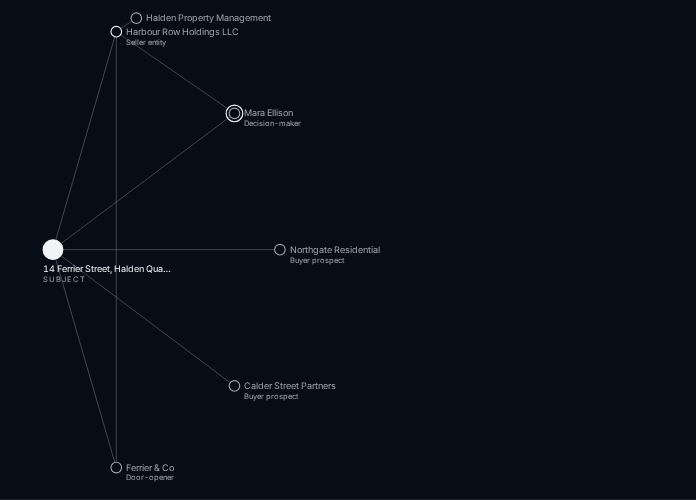
At 14 Ferrier Street, Harbour Row Holdings has held the building for 23 years. Its loan matures in nine months. Mara Ellison’s recent disposals make a conversation worth considering; they do not establish that she wants to sell.
Halden Quarter, its properties, parties and figures are fictional demonstration material.
01
Give the owner a reason
Compare retaining income, refinancing and selling. Show what a sale could release and what replacement opportunities would need to offer. Keep this constructive case even where intent is absent.
02
Find buyers beyond the postcode
Northgate Residential’s nearby purchases suggest a current strategy. Calder Street Partners’ operating experience suggests a different fit. Research the wider portfolios, not just the building count on this block.
03
Read appetite separately from fit
A capable buyer may have stopped acquiring or face financing constraints. Buyer 360 examines purchases, management, decision-makers and the case against each nomination; no fixed candidate quota substitutes for research.
04
Prepare the route
Keep the seller’s managing member, the buyer’s acquisition lead and relevant advisers distinct. Enrich their contact routes and explain why each belongs in the conversation. Your team decides whom to approach.
The broker brings an owner-specific value case and a researched buyer route to the first meeting—not two unrelated name lists.
Inside the conversation
Read the same property from each side.
14 Ferrier Street · Halden Quarter · fictional demonstration, not a live investment recommendation.
A reason to consider selling. A reason to keep holding.
- The record
- Harbour Row Holdings has held 14 Ferrier Street for 23 years. The demonstration loan matures in nine months.
- The commercial reading
- A sale could release capital for another investment. Refinancing could preserve the income and avoid a disposal. Neither the hold period nor maturity establishes intent.
- The case against
- A satisfactory refinance may remove the immediate reason to sell.
- The next conversation
- Take an owner-specific comparison into the meeting, rather than presenting maturity as distress.
Sell side
What the owner's position looks like
- Hold period and the gain built into the asset since purchase.
- Recorded mortgages, assignments, consolidations and the likely maturity window.
- Tax liens, court filings, open violations and signs of operating strain. A court filing is reported as a filing, not as an active foreclosure.
- Dated changes in control: an estate, a succession, a partner leaving. The cause is investigated, because the cause is the signal.
- A value case written for the owner even where there is no sign of intent: what selling, refinancing or trading up would do for them.
Buy side
Buyers with a reason to pursue.
- Recent buyers of comparable assets nearby and across the wider market.
- Neighbouring owners who would gain from assembling the block.
- Operators with a record of repositioning under-managed buildings.
- Portfolio size and holdings in other markets as a sign of capacity, not proof of appetite.
- Every unresolved candidate is researched, without a fixed list limit. Buyer 360 brings deal history, fit, buying rationale, decision-makers and contacts.
People and routes
From the property to the person who can say yes
Property, recorded owner, holding entities, controlling company, principals and decision-makers, lenders, advisers and gatekeepers. Each link carries its source. Confirmed links and inferred links look different, and a family name match stays a lead until something proves it.
Contacts are enriched for the people who matter and marked as checked, unchecked or inferred. PropTrova prepares the next step; your team decides whether and how to make contact.
Questions
Before you put it to work
Do you still build a sale case if the owner is not selling?
Yes. A constructive owner-facing case can compare a sale, refinancing or reinvestment with keeping the asset. It remains a hypothesis, with reasons to hold beside it. An absence of stated intent is not evidence that a sale would be unattractive.
Does a likely buyer list include Buyer 360?
When buyers are requested, Research includes their property fit, buying rationale, deal and operating history, decision-makers and contact routes. Discovery is not capped at an arbitrary number. Each candidate needs its own reasons; a listing of names is not a completed buyer reading.
Can a buyer with one local property still be a strong prospect?
Yes. Holdings and activity in other cities or countries can demonstrate scale, operating experience or an investment strategy. Local building count alone does not establish appetite. The analyst tests the whole portfolio against this particular property.
Are contacts permission to make an approach?
No. Research identifies a credible route and distinguishes recorded, inferred and conflicting contact evidence. Your team controls whether and how to approach. A family-name match does not establish identity, and a registered role does not automatically establish sale authority.
Bring a property, a submarket or a question.
See the owner, the opportunity and the people on the other side. Then open the research behind it.