
Opportunity discovery
Read the market before the property is marketed.
A PropTrova Walk turns a commercial area into properties, owners and reasons to act. See the holding and financing history, the people behind the entities, the owner’s value case and likely buyers, then take the promising buildings into deeper Research.
An open sample walk
Six buildings. Two sides of every opportunity.
In Halden Quarter, a maturing loan draws attention to 14 Ferrier Street. Nearby, a debt-free mixed-use building offers a different sale case: releasing equity rather than responding to a lender. A parking garage may interest an assembly buyer. Each building deserves its own reading.
This is a fictional district. All buildings, owners, loans and buyer examples are invented demonstration material, not live leads.
Halden Quarter · fictitious district
Pick any highlighted building.
Multifamily · 24 units
14 Ferrier Street
- Owner
- Harbour Row Holdings LLC
- Held
- 23 years, since 2003
- Recorded loan
- Matures 2027
- Who decides
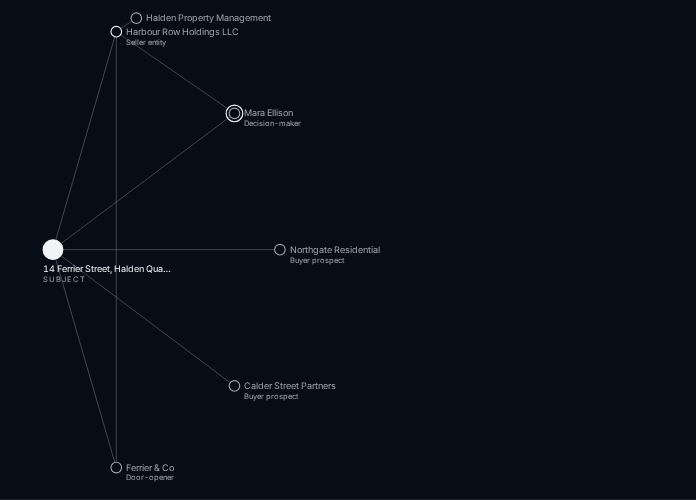
- Mara Ellison
Seller reading · Worth a conversation
- Long hold with a loan maturing in nine months
- Managing member's two other buildings sold since 2022
- Latest illustrative mortgage recorded in 2017
The owner’s position
A reason to consider a sale is not proof of intent.
A long hold, a maturing loan or a new trustee can open a commercial question. None is a sale instruction. Research considers the owner’s position: income, operating burden, capital needs, other holdings and what a sale could enable.
At 14 Ferrier Street, the loan and recent disposals merit a conversation. The owner might still prefer to refinance and retain the income. The sale thesis therefore needs a credible value case and an answer to the strongest objection, not simply a label saying “motivated seller”.
For an owner showing no intent, the question can be more constructive: would a sale and reinvestment create a better position? That remains an analyst’s hypothesis to test, not a fact about the owner.
Read the signals together
- Holding history and prior transactions: what has changed since the purchase?
- Recorded financing: maturity, refinancing history and the debt position the record can support.
- Operating strain and capital needs: distinguish evidence from an estimated burden.
- Changes in control or succession: resolve the event and the person now responsible.
- The case to keep the building: income, replacement options and reasons not to sell.
The buyer’s position
Who would want this asset, and why this one?
The buyer list is developed from the property, not a fixed quota. Nearby owners can have an assembly or management advantage. Recent purchasers can reveal a current strategy. A specialist operator may see a repositioning opportunity others would avoid. A buyer with one local building may have substantial holdings in other markets.
Buyer 360 examines the candidates’ purchases, portfolios, operating record and decision-makers. Portfolio scale provides context, not an automatic high-propensity label. Every name needs a concrete fit reason and a separate reading of whether the buyer is likely to act.
The sample shows Northgate Residential’s nearby buying and Calder Street Partners’ operating strategy. Those are different reasons to investigate. Neither is an expression of interest, available capital or a commitment to bid.
From the entity to the conversation
Find the person behind the property.
The recorded owner may be a company, partnership or trust. PropTrova follows the roles and relationships to the people who influence the decision. A registered agent is not silently promoted to owner; a possible family relationship does not become a proven identity.
The contact route belongs beside the reasoning. Your team can see why the person matters, the evidence for the connection and which route is suitable for the proposed conversation. Enrichment fills the route gaps without pretending that an email address alone establishes authority.
The working register
Take the walk back to your desk.
The branded workbook preserves the property register and the owner groups so your team can compare opportunities without rebuilding the list. Building-level records stay separate from the judgement about a person or portfolio. Missing information remains visible rather than being represented by a misleading zero.
Property register
Buildings, asset type, owner, holding history, last sale, recorded mortgage, assessed value, distance and available violation detail. Each field retains its meaning; assessed value is not presented as a market valuation.
Owner groups
Confirmed common decision-makers or holding structures, with the properties and available totals beneath them. Your team sees the scale of the relationship without treating an unresolved connection as settled.
Commercial reading
Seller value cases, reasons to hold, likely buyers and the rationale for each. Enriched contacts sit with the relevant owner or buyer so the first conversation is informed by the work.
From the walk to Research
Carry the signal forward. Test the whole property.
A promising building opens into property Research with the saved discovery context and your objective. The analyst examines ownership, economics, value and the counter-case in depth. The original signal is a starting point, not an instruction to conclude that a deal exists.
The resulting paper can support an owner meeting, an acquisition discussion or a financing question. Your team chooses the next action. PropTrova prepares the evidence and the route; people decide whether to approach or transact.
A walk also provides a basis for continued monitoring. A later transfer, financing event or buyer purchase can change the reading. Dated work remains preserved so your team can understand what moved and why.
Local records govern how the walk is read. PropTrova discovers and tests each place’s method rather than copying one city’s assumptions across the world. Where a record cannot establish an owner, the gap stays explicit.
Questions
Before you put it to work
Does a long hold mean an owner is likely to sell?
No. Holding period is one part of the reading. Debt, operating needs, changes in control, other transactions and the owner’s alternative position matter too. PropTrova develops a value case even when there is no sign of sale intent, and keeps the reasons to hold alongside the reasons to consider a transaction.
Can a buyer qualify without many buildings in this area?
Yes. A small local holding does not define the buyer’s whole portfolio. Research examines holdings elsewhere, recent acquisitions, operating experience and strategy. Scale can support the reading, but does not make a buyer highly likely on its own. Each candidate needs a property-specific reason to pursue.
What can I inspect in the open sample walk?
Select any highlighted Halden Quarter building to see its fictional owner, hold, loan and seller reading. Switch to the buy side to see example counterparties and fit reasons. The sample is open without signing up. It is an illustration, not a live market, a real owner list or an invitation to contact the named parties.
Which types of property can I include?
Commercial asset types include multifamily, mixed-use, office, retail, industrial, hospitality, development land and special-purpose assets. Special purpose covers parking garages, parking lots, staff accommodation and self-storage. Research follows the asset’s actual use and local record classifications; individual homes and private villas are outside scope.
How are owners grouped?
Research traces the entities and people behind each building. Confirmed control relationships support owner groups; similar names, shared addresses or possible family links remain leads until the record supports joining them. A group is not created merely because two entities look alike.
Does every market use the same public records?
No. Local methods differ. One place may publish parcel records, another transaction downloads, company filings or verification searches. PropTrova identifies the method, tests what it establishes and records the gaps. Market activity alone is not proof of ownership, and a title verification lookup is not automatically an address-to-owner search.
Bring the submarket you want to understand.
See how a Walk develops the owner position, the buyer rationale and the route to a conversation.